
Design the process, not the product
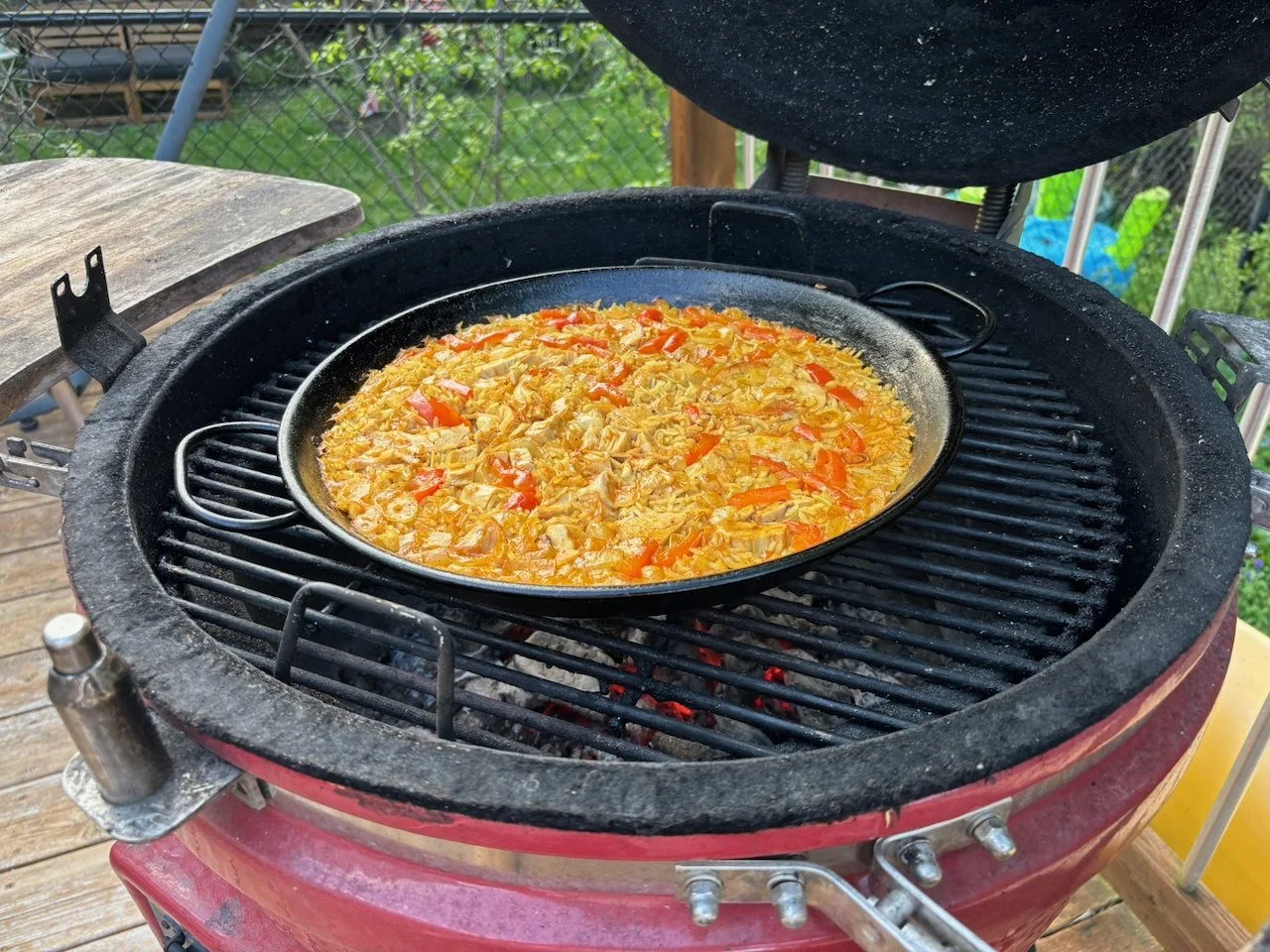
I like to think that I’m a pretty good home cook. One of my go-to dishes, especially in the summer months when I can cook outdoors on a real charcoal fire, is that Spanish classic “Paella”. At heart it’s the simplest thing: medium-grain rice with a bit of meat or beans, flavoured with paprika, saffron, and cooked in a flat open pan over a hot fire until the rice is tender while the bottom is browned and crispy-chewy.
There are innumerable different variations however. Many would include mussels or clams, or shrimp, or chicken. If you don’t mind being labelled a heretic and hounded by the Valencian culinary mafia, perhaps even some chorizo (controversial, but to my palate, a winner). We can adjust the proportions of spices and herbs, or add garlic or shallots; all are possible, and the end product can be recognizable as Paella.
But among cooks there is a deep divide over one specific act: do you add broth to rice, or rice to broth?
One would think this shouldn’t matter, since the end result can be delicious either way, and not even that different. The question “why one way and not the other” invites an inquiry into the fundamental origins of paella, not for its own sake- but because by understanding the reasoning behind the order of operations of the dish, we can gain more command over its execution.
I’m not just talking about food though; as with cooking, guitar making can benefit from the approach of “applied experimental archaeology”. The thesis is this: artifacts are products of cultures, not simply people. As genes are a unit of genetic expression, memes (in the pre-internet sense of the word) are a unit of cultural expression. And as in the ruthless world of biology, where every new mutation had to be viable in order to remain part of the gene pool, any new version of an artifact had to be viable in order for it to remain part of the culture.
What this means is that when it comes to made objects, whether a meal, a sailing ship, or a guitar, by gradually eliminating modern tools and practices we can retrace our steps backwards in time. By building a violin using only tools like those found in the Stradivarius workshop, we can potentially reconstruct how he made them; by banging rocks together, we can reconstruct how a paleolithic hunter made those impressive flint spear spear heads. We can learn about almost anything in between by applying the same idea.
And it works both ways: if we have tooling, we can sometimes reconstruct the object it was used to make. In archeological digs, bone needles have survived much better than leather or woven fibres, giving us insight into how long ago us humans were making complex clothing. Meanwhile, if we have only the object, by attempting to build it we can hypothesize the tools and methods used, which can also indicate or suggest the existence of further related objects or cultural practices.
The solera method of guitar construction is perhaps a good test of experimental archaeology. I can’t find any reference to when they first started being used, but is clearly rather a long time ago. One clue is in the name: the root word of solera is “sol”, meaning “ground” in latinate languages. That’s one of the most fundamental concepts humans have, and probably one of the first to be given a word; not only do we stand upon it, it is the ultimate plane of reference for our entire perception. In the case of lutherie, it doesn’t specifically refer to the earthen ground beneath our feet, but suggests a flat base upon which to build upwards.
And that is exactly what a guitar solera is for. First the soundboard is made and placed face down upon its surface. Then, the neck, integral with the neck block, is placed and glued down to the soundboard. Sides are inserted into slots in the neck block, and clamped down to the soundboard. Then, the braced back is placed on top of it all. The solera acts as the plan, the reference plane, and the workbench; all glue clamping pressure pushes downwards agains it.
If we are examining the origins of things, the simplest form is generally the most ancient. And the solera, being essentially a flat surface of the right size and shape, is probably the simplest structure of all. It also allows for more flexibility on the part of the luthier. We know from guild records that renaissance-era instrument makers were expected to be able to build several types of instruments to a professional standard. It is also clear that there were often several commonly used sizes for any given instrument, and very little standardization. Making a mold to maintain the shape of a body is all well and good, but it would be a lot of trouble to make a new one for every order. More likely mold-based construction became more prevalent later in history, when the economic situation favoured greater specialization and professionalization of lutherie.
But I don’t think we have any direct evidence or examples of how these earliest of guitars would have been made; as far as I know, no 16th-century guitar workshops have been preserved to any degree at all. We would have to look at the instruments themselves to provide clues to the process. Problem is, there is only one extant guitar from before 1600. That’s a small sample size, but we can can broaden it by considering also the Iberian vihuela, which is a very similar instrument. In fact, the modern guitar is more akin to the vihuela than to the early guitar, which was a smaller, four-course folk instrument closer in size and temperament to a modern tenor ukulele.
Looking in particular at a 16th century vihuela from the Museum of Music in Paris, we can clearly see how the neck block is carved with an extension against the back of the instrument, a detail known nowadays as a “spanish heel”. It’s a feature that is almost fundamental to the solera construction process. Also, that vihuela has a lovely fluted back, made from narrow sections of wood bent across the grain. Intriguingly, we find this exact feature in the single known 16th century guitar, on display at the Royal College of Music Museum in London. While the fluting is unusual, guitars made soon after frequently feature rounded backs, fixed to perpendicular sides. It is hard to imagine building any of these without a flat reference base against which to clamp; in other words, the shape of these earliest of guitar-family instruments strongly suggest that they were assembled on a solera.
Trying to go further back in time, we can’t even rely on instruments, because there aren’t any. But there are plenty of visual representations, of varying degrees of realism. It is clear that instruments similar to the guitar, with a peanut-shaped body, perpendicular sides, and a flat peghead, were in common use in Iberia throughout the 15th century, but not elsewhere. Some music notation and tablature has also survived from that era, supporting the story that this style of instrument originated there.
There were other plucked instruments around Iberia that were similar in some ways, but the differences support our origin story. The lute, for example, coexisted with the vihuela, but the two are made in very different ways. Probably the solera method of making vihuela-like instruments already existed by the time fretless lutes turned up with the Moors. While they ended up converging musically over time, the two methods of making them remained irreconcilable. The musical notation that has been found from the 15th and 16th centuries always specifies “for vihuela”; although the lute could be used to play it, that’s another point of evidence that the indigenous vihuela was already there and the lute adapted towards it.
Meanwhile, the first representations of bowed instruments show up in about the same time and place. Possibly it was imported (again, with the Moors) from western asia, or possibly it was independently invented there. To play an instrument with a bow properly, it helps a great deal to have a very sharply incurved waist. Indeed we see representations of instruments with that exact feature by late medieval times. Sometimes they are bowed, and sometimes plucked. This “viola da mano” (specifying that it is played with the hand) flowed, with the lute, into Italy from Spain. The lute was clearly the favourite plucked instrument there. The viola da mano could play lute repertoire, but notation was never specified for it, suggesting the lute came to Italy first.
Even though (being plucked) it wasn’t necessary, the viola da mano was made in the same manner as the bowed “viola da arco”: with a sharp c-shaped waist. It meant that each side was made of three separate pieces of wood, joined together at sharp corners. Clearly this would make more sense to assemble those joints around an inside mold. The outline of the body shape becomes the solid reference base, a fundamentally different approach to the solera. Soon, this new method would allow for the development of instruments with arched soundboards. Indeed, the inside mold approach is what we end up seeing preserved in Stradivarius’s workshop a couple of centuries later.
And as for plucked instruments, the shape with sharp indents in the waist seems to have quickly disappeared as the guitar spread, but the method of building them around an inside mold survived, especially the further away one travelled from Spain. The Viennese and Mirecourt schools ended up being highly influential, following perhaps the fortunes of their respective countries, when the switch from doubled courses to single strings occurred. And one of these luthiers, a certain C.F. Martin, took his talents to fast-developing America, where subsequent iterations of his viennese-school model became the de facto standard guitar. That is just part of the winding path of the evolution of the modern guitar. But in the Spanish-speaking world, the solera method remained pre-eminent even as the guitars grew, changed shape, changed stringing, and changed sound.
So it seems fair to conclude that using a solera to make a guitar-like instrument is the original method, developed in what is now Spain at some point in late medieval times. But the more important point is this: the way these instruments are built is the reason why they are the shape that they are.
The way a guitar is assembled is not a minor decision to be made by the luthier; it is fundamental to how it is shaped, which is fundamental to how it feels and how it sounds. Luthiers (indeed probably most craftsmen) of the past did not draw an object and then figure out how to make it- they knew how to make a thing, or things in general, and used that knowledge to adapt, stretch and squeeze and pull out new forms. Why design a guitar one way and not another? Because the simplest and surest route to success is to follow the simplest and surest path. Follow the oldest of old recipes, but change up some of the ingredients. The beautiful fundamental structure of guitar making has been established; one can only add more complication, not less.
Like the lute, rice came into Spain with the Moors, and was changed by it. Back to applying experimental archaeology to paella, we can assume that the simplest form is the closest to the original. As with the “solera”, the name itself tells us the foundation upon which the edifice is constructed. A “paella”, literally, just means “a pan”. It is the solera of rice. Besides that rice, it is not the ingredients that make the dish; the manner of cooking it is.
So let’s imagine ourselves in rural Valencia, more or less any time between the dark ages and the twentieth century, with few resources but a metal pan, our staple food (rice), and locally foraged ingredients. First we start a small fire with pine and orange-wood branches. The wide pan is easily balanced astride the fire on three rocks or bricks. Now, do we fry the rice with some olive oil and herbs, and then add broth? Wait a minute: where are we going to get the broth? We only have one pan, and no stockpot, never mind the time to cook up a proper consomme. If we instead add water directly to the frying rice we create a different problem- all that cold water takes time to come to a boil again on our little fire, threatening to make our rice both gluey and chalky.
The solution presents itself easily: make a quick broth in the pan (or paella) itself, and add rice to it while it’s hot. An authentic and original source of protein in rice growing areas is the “rata de marjal”, a small semi-aquatic rodent. Simmered in water seasoned with salt, saffron, and paprika, they become tender and share their meaty essence quickly; add the rice (and perhaps some green beans or artichoke hearts) to the bubbling, pale yellow concoction, and cook until the water is absorbed and crackling sounds can be heard. Set it aside off the fire for a couple of minutes, and dig in with friends.
This must be the original method of paella; nothing could be simpler, or better. And now that we understand why it’s done that way, we can make it our own- even if that means adding a bit of chorizo.
Quisque iaculis facilisis lacinia. Mauris euismod pellentesque tellus sit amet mollis.