
Arguably, a glossary
Language evolves- that much is certain. As I write this, I am in Mexico City, one of the world’s largest, a vibrant, hustling place that seemingly never sleeps (except, perhaps, on Sunday morning). My rudimentary learning-app-based spanish is enough to reliably get my coffee order across, but conversations between locals are hard to follow; the differences in pronunciation between european and mexican spanish are significant. I even have a nifty phone translation app that can translate the text directly from an image; while it can generally decipher a menu, more vernacular sources such as street posters and graffiti are often beyond its abilities.
This is all well and good; the world changes, people change, the language changes. But there are drawbacks; what to do, for example, when the language changes but the thing it is being applied to hasn’t, or more to my point, shouldn’t? Some terms would benefit from more robust definitions. Specifically I’m a guitar maker, I want to address some of the ones that we use in our profession when describing a guitar. And I’m going to be a bit hard-core about it.
There are plenty of perfectly good terms out there that can be used to describe excellence, but the general trend is to apply it to those things which are more and more mundane. As language evolves there’s a strong trend towards using more and stronger superlatives, which of course renders them less potent. Like addicts, we develop a tolerance; just think of how you felt when you first heard a parent say “Fuck”… and how you feel now that you say it yourself ten times a day without a thought. So a younger generation ends up having to generate new superlatives to catch the same high, which is problematic because if we’re not all familiar with the new ones we won’t all understand each other. An inability to accurately describe the excellence of something will inevitably lead to people being disappointed in things, or worse, in each other.
And of course corporate and business interests will enthusiastically bend the meaning of words to suit their purpose, which is almost always simply to sell you more of whatever they have. Words are cheap, and quality is expensive. If your existence is predicated on your success at buying low and selling high, then conserving meaning for the greater good of society is not going to be a priority.
As an artisan, I follow a different credo. Part of the appeal of my personal production output is that I say what I mean, people trust what I say, and I try very hard not to disappoint them. If I did, I’d go out of business. A bigger company making bajillions of guitars can certainly afford to disappoint; in fact they’re probably already got an algorithm to determine the exact amount of disappointment that provides the optimum profit margin for their particular product (ever been been booted from a flight because it was overbooked? That algorithm). What’s more, that big company (and their competitors) can flood the market with enough mediocre product that no-one knows what actual quality looks like anymore, or what the word even means, again working against those who would continue trying to sell an excellent product.
So even though it must make me seem fuddy-duddy to champion old words in our Brave New World, I feel the need to try. This is my attempt to define some words I commonly encounter, in relatively immutable terms so that they may be less prone to devaluation. You might take issue with some of it, but that’s the point. Language evolves, after all, through use- so I look forward to engaging with dissenting opinions, in writing (even if they’re wrong).
Quality: I know, I was just ranting about trying to establish definitions that are absolute, but quality is always relative. For any given object there exist a continuum between the highest quality, meaning the best that exists in reality, and the lowest quality, meaning it probably represents the object in name only. But I feel that we should only measure the quality of something by referring to aspects of it which are universal and/or quantifiable, and not those that are subjective. For an acoustic guitar, this would mean that it is loud and full-sounding, that it is easy to play, and that it is sturdy enough to evoke a feeling of confidence in the player. I would argue though that comparing it to existing instruments to determine “quality” is not useful. A guitar that’s great for bluegrass probably won’t be good for flamenco, but that doesn’t suggest any change in quality, just suitability.
And any given musical style is more ephemeral than you imagine. Musical preferences change, but quality should be a term that can be applied to things independently of time and fashion. Go to the right museum and you might find objects made for kings and queens, by the finest master craftsmen of their day. You might see a strange object, intricately carved from translucent horn or tortoiseshell. It clearly required extraordinary skill and time to create, and having survived this long it must have been built well. If you were to hold it you might find it nestles easily into the hand, light but well-balanced. But what is it? A scientific instrument? A drawing implement? A bauble? It’s possibly an object which we no longer even use in modern life, like a wig-holder or, I don’t know, a candle-wick-straightener. But, with a little imagination, we can tell that it was an object of uncommonly high quality. Fashions change, needs change, but quality should be discernible independently.
Custom: something about this guitar was made on request just for you. A “blueberry crush sparkle” finish isn’t custom. A “blueberry crush sparkle finish, like you asked” is.
Custom Shop: this is a place where those custom orders get implemented. It might be a workshop, or a team, or a person, who may be part of a larger organization, or not. Even if they aren’t making the whole guitar on their particular workbench, if they’re the ones making sure that you get the “blueberry crush sparkle finish” on your particular guitar, that’s a custom shop. It’s a pretty broad designation, and doesn’t guarantee any particular quality level. But having something made the way you want it, even just a little bit, is a gateway drug to the next step:
Bespoke: this specific guitar was made specifically for you. It’s more than a collection of modular pieces that were destined to be put together in some configuration or another. “Bespoke” describes an instrument that is not just “another one rolling out the door”; whether from the hands of the most exclusive low-volume luthier or a higher-production workshop, if you hadn’t ordered this exact guitar it simply would never have existed in the first place. Details were specified to your liking in conjunction with the luthier or their representative. Yes, perhaps most of your choices were relatively unimaginative, but if you know a 24.75” scale length works for you, then it’s the right choice, even if it’s an obvious one. The point is that it was a choice, and that you had the opportunity to make many choices. Obviously, you chose the luthier because they’re already working in a style that you like. And like you, the luthier gets to make choices too: they can tell you that they’re, I don’t know, morally opposed to “blueberry crush sparkle”, and direct you to either choose another colour or choose another luthier.
Boutique: literally, it’s just the french word for a shop. As the English language has been prone to do since my old-french-speaking ancestors defeated my anglo-saxon-speaking ancestors and set themselves up at the top of the socioeconomic pyramid, it adopted the french word to indicate a more upper-class shop. Think “atelier” (workshop), “Chauffeur” (driver), “promenade” (walkway), and pretty much every word referring to good cooking (cuisine), high fashion (couture), or fine art (art!)- all originally french.
In other words, a boutique is a shop for people who want (and can afford) expensive or at least high-class things. A “boutique” guitar is one that you are unlikely to find at a strip-mall guitar shop with only slot-wall and a cigarette-burned Peavey Bandit for decor. It’s partly a matter of price (expensive stuff tends to sell better in expensive stores, because that’s where expensive people go) and partly a matter of exclusivity: a boutique guitar is not going to be made and distributed in such quantity that it can end up in every Guitar Center in the land. They are not boutiques; guitars found there are unlikely to be boutique guitars, simply because they will be vastly outnumbered by quicker-to-produce mass-produced instruments. There can be exceptions of course; one friend recently found a sought-after Brunello wine from an exclusive Tuscan vineyard in the sale bin of the local grocery store. If you happen upon a Teuffel Birdfish in your neighbourhood Buy-‘n-Sell, you can call that shop whatever you want.
This “boutique guitar” being sold in a “guitar boutique” might be “custom”, or it might be “bespoke”, or neither. Hopefully we can say it is of high “quality”, but that is not guaranteed.
Handmade: oh boy, this is going to raise some hackles. It certainly raised mine, since I suppose it means most of my guitars wouldn’t quite qualify as being “Handmade”. But then, so many things get called “handmade” now that the term has effectively lost all meaning. This ends now. I’m going to draw hard lines around my definition, because that is the only way to prevent “meaning creep”. I propose, as a starting point:
“The final dimension of every single wooden part of the guitar was achieved with a tool that was powered entirely by the muscles of the maker.”
A few examples to illustrate:
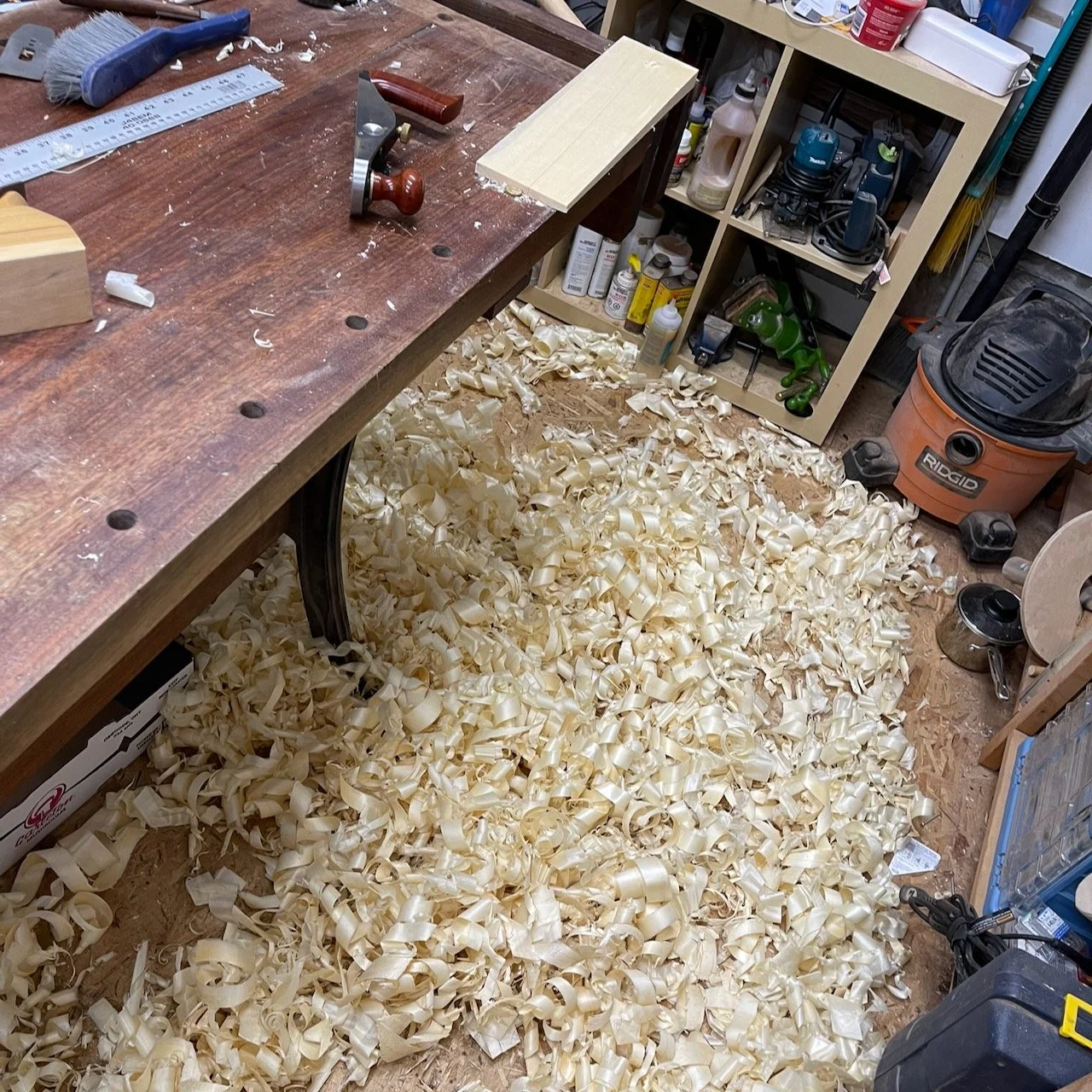
-Did you use an electric thickness planer on the soundboard? Fine, if you then used a hand plane to reach the exact final thickness you were shooting for. Even if you only actually removed a few shavings’ worth of wood, that is such a critical dimension that the input from your hands makes a genuine difference to the end product. Handmade, so far.
-Did you use a concave wood block wrapped with sandpaper to radius the fretboard? Did you push it back and forth until your arms were tired? It’s slow, laborious and messier than necessary. It’s not very craftsmanlike. But it is definitely Handmade!
-Did you use a router and a jig to cut the dovetail for the neck-body joint? It might still be handmade: let’s face it, you’re going to be doing some trimming with a sharp chisel, and probably some judicious sanding in some delicate spots, because it’s a critical joint and the templates are never quite accurate enough. Unless you’re so good with a router that you don’t need to trim, in which case: hats off to you! I won’t tell anyone ;)
-Did you use a bandsaw to cut out the body shape? I suppose it could still count- if you used a drawknife, spokeshave, or your teeth to remove the saw marks and refine the shape to its final form. Did you use a spindle sander for that part? No longer handmade, even if afterwards you held a piece of fine sandpaper in your hand and rubbed it until you got blisters. That little bit of final hand sanding pretty much only removes prior sanding scratches (or tool marks) without appreciably altering a dimension.
-Did you use a CNC router to carve the neck? Not handmade, unless you broke out the spokeshave afterwards to substantially change the neck profile. And if you did that, then you’re probably using your CNC wrong.
Are you pissed off yet? Don’t be: notice how in no way, shape, or form did I suggest that “handmade” equates with “better”, or even “good”. It’s simply a term that describes a method, not a quality level. There are plenty of awful objects out there, made crudely by the hands of someone who doesn’t have the skill, the time, or simply doesn’t care. Repeat after me:
“the term ‘handmade’ denotes only how, not how well!”
Yes, I know this definition is pretty exclusionary. There are few acoustic guitar makers who would meet it, and as far as electric guitars go, there are practically none in existence that would. And that’s fine. Why should they? The electric guitar is an invention of the industrial age after all. Its development was, by historical standards at least, quite sudden and deliberate; it did not slowly evolve from precursors whose design was dictated by the limitations of what could be done with a tiny toolkit which grew only gradually over the course of centuries.
Now, I know a lot of people making great guitars who put a lot of attention into detail, and spend an enormous amount of time on handwork; but a lot of this handwork involves cleaning up the toolmarks and blind spots from the CNC router. A lot of care and precise hand workmanship will go into things like the fretwork and the nut. But I don’t think we should be calling the guitars handmade. They may be superbly crafted and thoughtfully designed; they may be precisely honed tools for the most technically proficient players; or they may be thought-provoking singular works of art, or all of the above. But “handmade” should not be used as their sole descriptor.
What we really need is a new term for these instruments, the ones designed and made by an individual luthier who has dedicated their life to making guitars with intentionality and integrity.
Perhaps, in fact, we already have that term: “Boutique Guitar”!
Quisque iaculis facilisis lacinia. Mauris euismod pellentesque tellus sit amet mollis.